
You're Leaving Hard Cash on the Table Every Time You Ignore a Google Review
The data is clear: local businesses that respond to reviews grow faster, convert more shoppers, and build lasting customer loyalty. Here's everything you need to know — and do — right now.
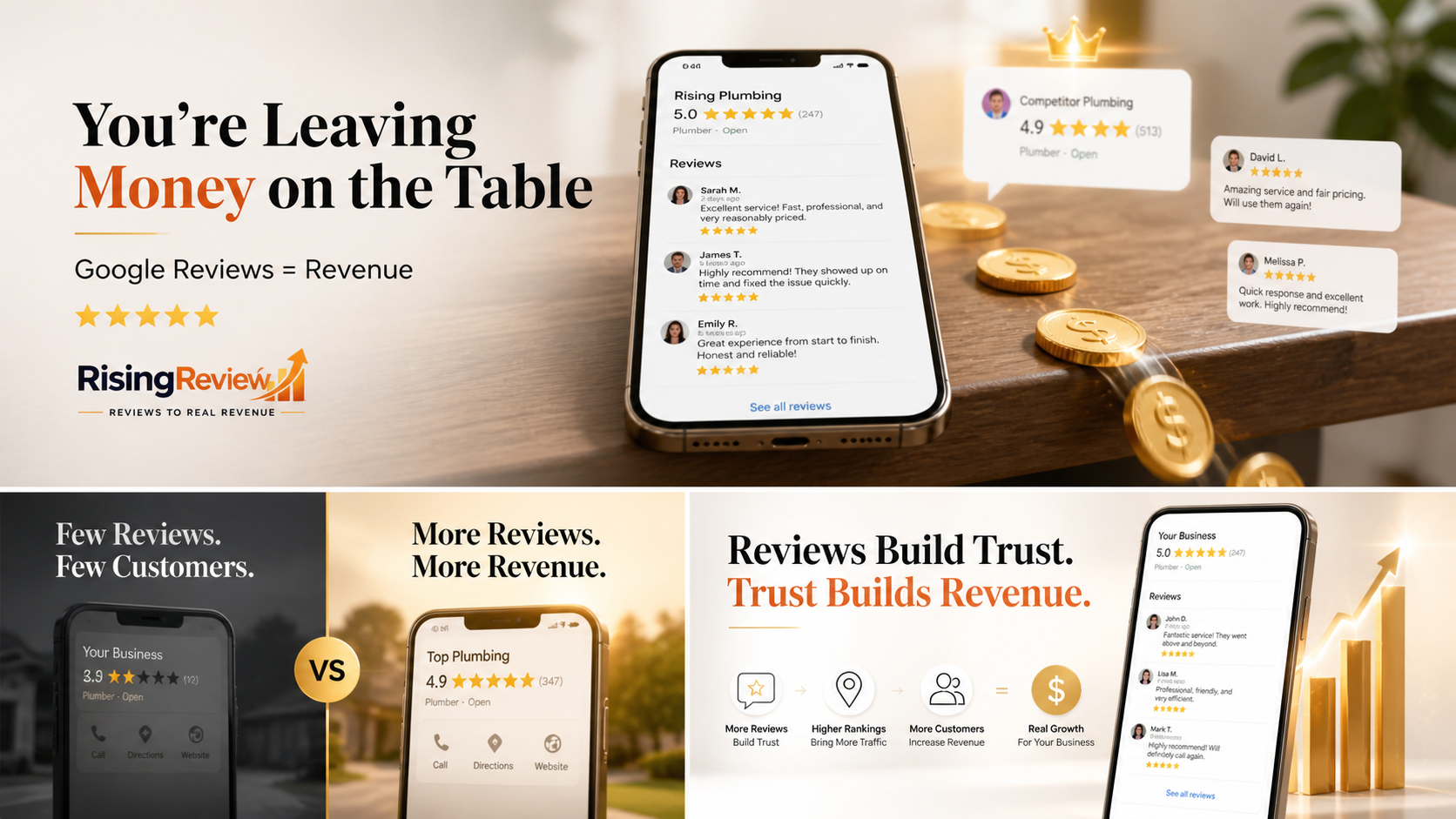
Let's cut to the chase. If you own a local business — a restaurant, a salon, a plumbing company, a boutique, a dental practice — and you are not actively managing your Google reviews and responding to them consistently, you are making your competitors richer. Not metaphorically. Literally. There is revenue you should be earning that is flowing somewhere else, and the reason is sitting in plain sight inside your Google Business Profile, waiting to be addressed.
This isn't about vanity or reputation for its own sake. This is about money. Customer acquisition. Lifetime value. The kind of growth that compounds month over month and turns a solid small business into a local institution. Reviews — and how you respond to them — are one of the highest-leverage tools available to you, and most local business owners either underestimate them or ignore them entirely.
That ends today.
✦ ✦ ✦
The Numbers Don't Lie
Before we get into what to do, let's establish why this matters so urgently. Research into consumer shopping behavior consistently reveals the same truth: reviews are not a nice-to-have feature of your online presence. They are the front door of your business in the digital age.
Read those statistics again, slowly. Four out of five of your potential customers are going to look you up before they ever walk through your door or pick up the phone. More than a third of businesses that go from no reviews to a solid review base see a meaningful jump in sales. The recency of your reviews matters to nearly nine in ten shoppers. And over half of all buyers are actively hunting for your negative reviews.
That last one might sting. But it's actually good news, and we'll explain exactly why in a moment.
The bottom line is that your Google reviews are not just social proof. They are a revenue engine. And right now, for most small local businesses, that engine is either idling or stalled completely.
The Three Pillars Every Local Business Owner Must Understand
A healthy, revenue-generating review presence is built on three interconnected pillars. You need all three working together. Think of it like a three-legged stool — remove any one leg and the whole thing tips over.
Pillar One: Quantity
The number of reviews you have is the foundation. More reviews directly correlates to more trust, more conversions, and more sales. The research is consistent: businesses with higher review counts outperform those with fewer reviews, even when the rating scores are similar. Why? Because volume signals legitimacy. When a potential customer sees 12 reviews, they wonder if you're real. When they see 150 reviews, they trust the consensus.
And the effects compound in ways you may not expect. After just eight reviews, you'll start to notice an increase in organic search traffic — meaning Google itself begins to reward you with better placement because it recognizes your business as active and credible. Once you reach the 100-review mark, you have enough data to start identifying genuine trends in what your customers love (and what they don't), which becomes a marketing and operations goldmine.
Pillar Two: Quality
A hundred shallow, one-sentence reviews don't carry the same weight as a hundred detailed, specific, descriptive reviews. Quality matters — both to Google's algorithm and to the human beings reading them. Ideally, you want reviews that are three or more sentences long, that mention specific services, products, or experiences, and that give future customers something concrete to identify with. The goal is review content that's so rich and specific that it essentially writes your marketing copy for you.
Think about that for a second. Your happy customers, describing their experience in their own words, is the most authentic, persuasive advertising your business can have. One marketing expert put it perfectly: "Our customers are basically writing our marketing copy for us." That's the mindset shift local business owners need to make.
Pillar Three: Recency
A glowing review from two years ago is worth a fraction of what it was when it was written. Shoppers are deeply influenced by recency — 85% of them say it matters. An outdated review signals to a potential customer that either your business has changed, your customers have stopped caring, or you've stopped paying attention. None of those impressions help you close the sale.
This means review generation can't be a one-time project. It has to be a consistent, ongoing practice — something woven into the fabric of how you do business every single day.
Why Responding to Reviews Is the Move Most Local Businesses Miss
Here's where we get to the heart of it. Collecting reviews is important. But responding to them? That's where the real revenue lever lives — and it's the one most local business owners leave completely untouched.
When you respond to a review, you are not just talking to the person who left it. You are talking to every single future customer who reads that exchange. Think of it as a public performance of your customer service values. Your response tells prospective buyers: This is how we operate. This is how we treat people. This is what you can expect from us.
A customer reading your reviews isn’t just absorbing what others experienced — they’re watching how you respond to those experiences.
Your response to a negative review often tells them more about your business than a hundred five-star ratings ever could.
What they really want to know is: what happens if something goes wrong?
The consumer psychology here is well-established. Shoppers want to know that if they have a problem, someone will actually listen and respond. When they see a business owner engage thoughtfully with a frustrated customer — acknowledging the experience, offering to make it right, treating the person with dignity — it builds more confidence than any five-star review could. It proves that your business is run by real people who care.
And when they see a business with 40 reviews and zero responses? They move on. They assume you're not paying attention. And they're probably right.
The Negative Review: Your Secret Weapon
Remember that statistic? Fifty-three percent of consumers actively look for negative reviews. If that number made you cringe, we want to reframe it entirely — because negative reviews, handled correctly, are one of the most powerful conversion tools you have.
Here's why: when a potential customer seeks out your negative reviews, they aren't trying to find reasons not to buy. They're trying to understand the full picture. They want to know what the worst-case scenario looks like, and whether you're the kind of business that handles it well. A negative review with no response is an alarm bell. A negative review with a thoughtful, empathetic, professional response is a trust signal.
Consider this scenario. A customer leaves a three-star review complaining that your service took longer than expected. If you say nothing, every future customer reading that review wonders if their experience will be the same — with no recourse. But if you respond, acknowledge the delay, explain what happened, and invite them to give you another chance, you've just turned a liability into a demonstration of your character. The future customer thinks: OK, even when something goes wrong here, the owner steps up. That's a business I can trust.
The goal of responding to a negative review is not to defend yourself. It's not to win an argument. It's to create a reassuring narrative for the silent majority of future buyers who are watching how you handle adversity.
The Art of the Response: What to Actually Say
This is where many business owners freeze up — especially when it comes to negative feedback. Do you apologize? Do you explain? Do you push back? Here's a practical framework:
- Always acknowledge the experience. Even if you don't believe you did anything wrong, the customer felt something negative. Recognize it. "I'm sorry to hear your visit wasn't what you expected" costs you nothing and opens the door.
- Don't be defensive. Your response isn't a courtroom. The moment you start sounding defensive, you've lost every future reader who's watching.
- Use it as an education opportunity. If a customer misused your product or service, or had unrealistic expectations, a graceful response can gently clarify without making them feel foolish. This also serves future customers who might have the same question.
- Be careful with blanket apologies. You don't need to apologize for something that isn't your fault. But you should always address it. There's a difference between "I'm sorry" and "I understand your frustration."
- Invite them back. End with an offer to make it right. A direct line to you, an invitation to return, a commitment to do better. This signals confidence and care simultaneously.
- Respond to five-star reviews too. A quick thank-you on a glowing review takes thirty seconds and reinforces that you're present, grateful, and engaged. It also shows future customers that you celebrate wins as much as you address problems.
Reviews Are SEO Gold — And Most Local Businesses Have No Idea
Your Google reviews don't just influence how customers feel about you. They influence where you show up in search results in the first place.
Every review your customers leave is packed with natural, keyword-rich language that Google's algorithm uses to understand your business. When someone writes "the best deep-dish pizza in downtown Springfield" or "fastest oil change I've found on the south side," they're using language that connects your business to the specific searches people make. This is organic SEO happening in real time, written not by a marketing agency but by your actual customers.
The more reviews you have — and the more detailed they are — the stronger your local search presence becomes. You become easier to find. And easier to find means more revenue. It's that direct.
Your responses also matter for SEO. When you respond to reviews and naturally incorporate keywords related to your business and location, you're adding more relevant content to your Google Business Profile. Google reads all of it.
How to Start Generating More Reviews — Without Being Awkward About It
The single most common mistake small business owners make is assuming that great service alone will generate great reviews. It won't — at least not at the volume you need. Most happy customers mean to leave a review and simply forget. The solution is a consistent, low-friction system for asking.
Email Is Your Highest-Performing Channel
If you have any kind of customer email list — even a small one — you have a review engine waiting to be activated. A simple, friendly email sent after a purchase or service call asking for honest feedback converts remarkably well. You don't need elaborate copywriting. You need authenticity, a clear ask, and a direct link to your Google review page.
A single well-crafted review request email, sent consistently after every transaction, can transform your review count within weeks. And a follow-up email — sent to customers who didn't respond to the first one — can drive an additional 60% more reviews submitted. This is one of the most reliable and repeatable systems in local business marketing.
Leverage Your Social Media Presence
You're likely already posting on Facebook, Instagram, or Nextdoor. Use those platforms to periodically call your audience to action — ask them directly to share their experience on Google. You can highlight a positive review (with permission), explain why reviews matter to a small business, or simply make an honest, human ask. Most of your social followers are people who already like you. They often just need a gentle nudge.
Train Your Team to Ask In-Person
Your staff are the most powerful review-generation tool you have. A simple, sincere ask at the end of a positive interaction — "It would mean the world to us if you left us a Google review, here's how" — works. Make it part of your service culture. Print a small card with a QR code that links directly to your Google review page and hand it out with every receipt or service summary.
Never Incentivize Reviews — But You Can Run a Sweepstakes
Google's guidelines prohibit directly paying for reviews. But there's a legitimate, effective middle ground: periodic sweepstakes or giveaways where customers are invited to leave an honest review and are automatically entered to win a prize. The prize doesn't need to be extravagant — a gift basket, a service credit, a gift card — something that feels meaningful without being transactional. Done right, this approach can rapidly accelerate your review volume during slower seasons or around a new service launch.
The Revenue Equation: What This Actually Means for Your Bottom Line
Let's make this concrete. Imagine you run a local HVAC company. You have 15 Google reviews, a 4.1 star rating, and you respond to maybe one review every few months. Your competitor down the street has 120 reviews, a 4.6 star rating, and responds to every review within 48 hours.
When a homeowner in your area searches "HVAC repair near me" at 9pm on a Tuesday because their air conditioner just died, whose profile do they see first? Whose profile makes them feel immediately confident? Who gets the call?
This is not a hypothetical. It's the daily reality of local business competition, and it plays out in restaurants, law firms, auto shops, real estate agencies, and every other category of local commerce. The businesses that have built a robust, active, well-managed review presence are capturing customers that should rightfully be yours.
Review programs don't just help today — they build on themselves. More reviews improve your search ranking, which sends more customers to your profile, which generates more reviews, which improves your ranking further.
Getting started is the hardest part.
Every week you wait is a week of compounding growth you're giving away to your competitors.
And consider the lifetime value calculation. If a new customer found you through your Google reviews and spends $500 with you this year, and returns twice more next year, and refers two friends who each spend $500 — you've generated thousands of dollars in revenue from a single review that led someone to trust you. The cost of generating that review? A two-minute follow-up email and a heartfelt thank-you response.
✦ ✦ ✦
Your Action Plan Starts Today
Here's the reality: you don't need a big marketing budget to do this well. You need consistency, intention, and a system. Here is what you can begin immediately, without spending a dollar:
- Audit your current Google presence. How many reviews do you have? What's your average rating? When was the last review left? When did you last respond? Be honest with yourself.
- Respond to every existing unanswered review today. Positive ones, negative ones, all of them. This signals to Google and to future customers that you are active and engaged.
- Create a review request email. Keep it simple, make it personal, include a direct link to your Google review page. Send it to every customer who transacts with you going forward.
- Commit to a response timeline. Within 24 to 48 hours of any new review — positive or negative — you respond. Make this a non-negotiable operating standard.
- Brief your staff. Everyone who interacts with customers should know how to make a natural, comfortable ask for a review at the close of a positive experience.
- Plan quarterly review pushes. Pick one period per quarter to run a concentrated review generation effort — a sweepstakes, a social campaign, a special email sequence. Keep your content fresh and your numbers climbing.
- Mine your reviews for insights. Read what customers are actually saying. The patterns in their language will tell you what to emphasize in your marketing, what to fix in your operations, and what your real competitive advantages are.
The Bottom Line
There is a version of your business that is more visible, more trusted, and more profitable than the one you're running today. The gap between where you are and where that version exists is not massive marketing spend or a complete brand overhaul. It's a consistent commitment to the conversation your customers are already trying to have with you.
They're leaving reviews. They're reading your responses — or noticing that you have none. They're making decisions about where to spend their money based on what they find.
The question is whether you're showing up for that conversation, or leaving the field open for your competitor to win it by default.
Your Google reviews are one of the most powerful, underutilized growth tools in your business. Start treating them that way — and watch what happens to your bottom line.